


This article is for CISOs, cyber security and risk leaders, and assessors who need to understand what the move from the Essential Eight to ASD Essentials means in practice. It explains the key changes to assessment, scoping and reporting, and provides practical guidance on how to start preparing for the transition. By the end, readers should have a clearer view of what changes, what can be carried forward from existing Essential Eight work, and where to focus next.
“Are we Essential Eight compliant?” It is a question practitioners have heard for years, but it is becoming the wrong one. ASD Essentials shifts the conversation from whether prescribed controls are present to whether security outcomes actually hold up in the environment.
ASD Essentials was launched by the Australian Signals Directorate (ASD) on 15 October 2026, introducing dedicated guidance for Enterprise IT, operational technology (OT) and cloud environments. During the transition, ASD will maintain both the Essential Eight and ASD Essentials frameworks on cyber.gov.au, alongside supporting resources and implementation guidance. Existing Essential Eight work is not discarded: ASD’s transition guidance explains how existing controls and evidence can be carried forward, reused or strengthened as organisations move to ASD Essentials for Enterprise IT.
What is the difference between Essential Eight and ASD Essentials?
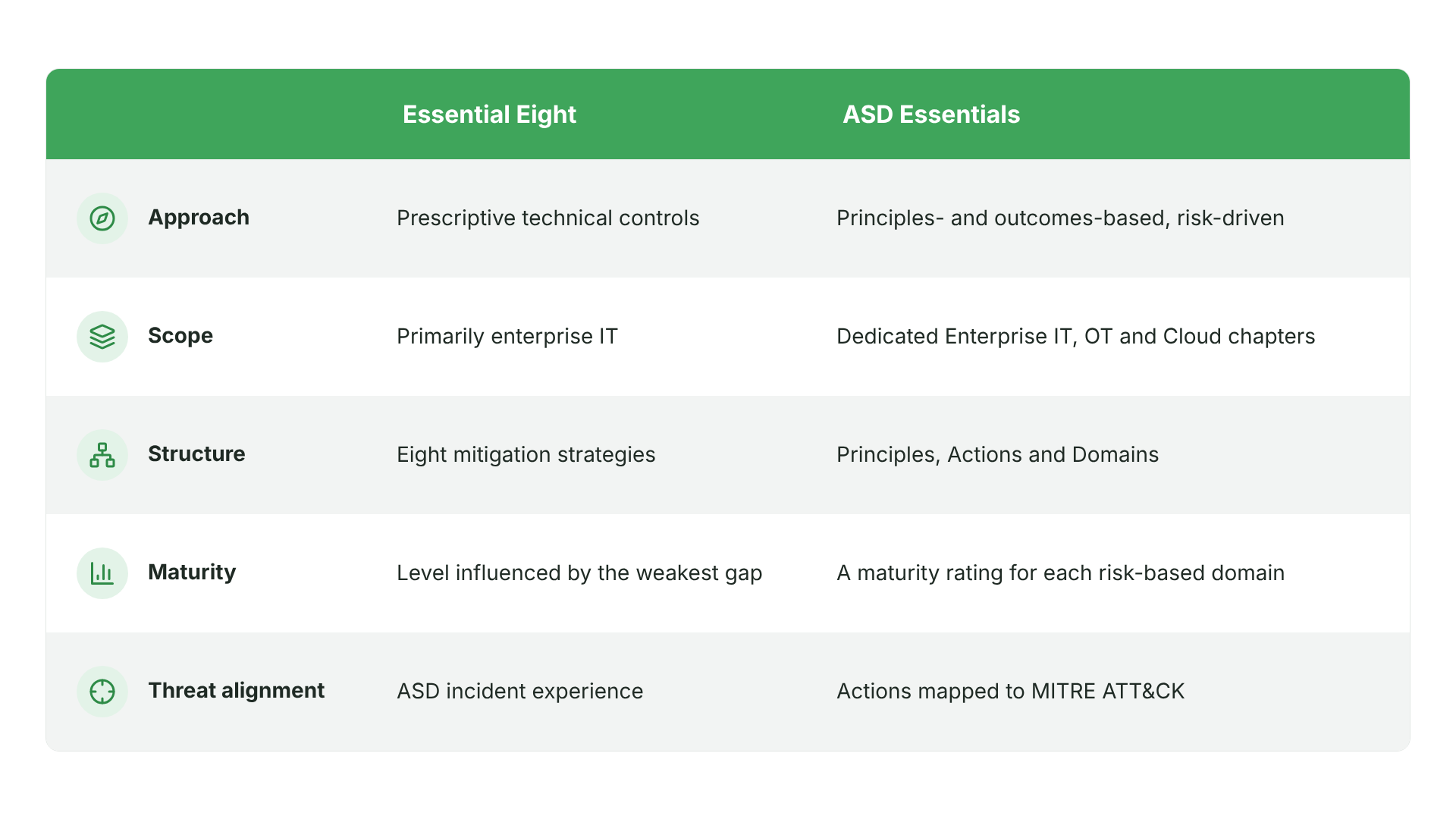
The biggest change is philosophical. The Essential Eight is a defined set of technical mitigation strategies. ASD Essentials is principles- and outcomes-based: organisations determine how to achieve the required security outcomes and assessments focus on whether those outcomes are effective.
What are the benefits of ASD Essentials?
It fits modern environments. Dedicated Cloud and OT chapters allow those environments to be assessed directly rather than stretching desktop-focused controls to fit.
Ratings can show where risk sits. Domain-level maturity can distinguish stronger areas from weaker ones, rather than allowing a single significant gap to obscure progress elsewhere.
It rewards security that works. An outcome focus moves assessment beyond collecting evidence that a control exists and towards whether it achieves its purpose.
It connects assessment to threat operations. Mapping Actions to MITRE ATT&CK gives assessors, security operations and threat teams a more consistent language.
It gives leaders a clearer role. Senior executive guidance supports a discussion about cyber risk and effectiveness, rather than a simple compliance result.
How will ASD Essentials assessments differ from Essential Eight assessments?
On paper, an Essential Eight and ASD Essentials assessment may look similar. In practice, the assessor’s role shifts from verifying prescribed controls to judging whether security outcomes are being achieved and explaining the evidence and reasoning behind that judgement.
Scope starts with the business. Discovery needs to identify critical functions and applicable chapters, bringing cloud, OT and executive stakeholders into scope where relevant.
Domains matter. Risk-based domains are defined with the client because the way they are drawn shapes both the assessment effort and the maturity picture.
Testing asks “does it work?”. Controls are still tested, but the assessment must consider whether the intended outcome holds against the attacker techniques to which it is mapped.
Reporting serves two audiences. Executives need a maturity and risk view by domain, while security teams need the underlying technical findings and threat mapping.
Roadmaps prioritise risk. Remediation becomes less about chasing the next maturity level everywhere and more about investing first where risk reduction is greatest.
The transition may require both frameworks. Where clients still need Essential Eight reporting, evidence can be gathered once and mapped to both frameworks where practical.
The trade-off: judgement becomes more important.
Outcome-based assessment provides flexibility, but it also increases the need for a consistent method, transparent reasoning and peer review. Organisations should also expect existing evidence packs, policies and reporting to require re-mapping during the transition.
Does ASD Essentials apply to small businesses?
ASD Essentials is aimed at government, critical infrastructure and larger organisations. For a small business, applying the full framework may create disproportionate cost and complexity. That does not mean doing nothing. It means choosing a framework and level of assurance that fit the business and its customer obligations.
- Get the basics right: MFA, timely updates, tested backups and staff awareness.
- Use the Cyber Health Check or an IT provider to establish a practical baseline.
- Check contracts, tenders and insurance requirements for changing Essential Eight expectations.
- Choose a framework that fits: ACSC’s Small Business Cyber Security Handbook is a practical starting point; SMB1001 provides staged maturity and certification; ISO/IEC 27001 may suit organisations that need formal certification for enterprise or government supply chains.
Where should organisations start with ASD Essentials?
- Keep the Essential Eight baseline current. It remains relevant to Enterprise IT.
- Define critical functions and domains early. Poor domain design can hide risk or increase effort.
- Look closely at Cloud and OT. These are areas where the new structure adds dedicated coverage.
- Brief executives before reporting changes. Shift the conversation from “are we compliant?” to “how effective are we, and where?”
- Select assessors on method, not availability alone. Ask how judgement will be applied consistently and evidenced.
The bottom line
ASD Essentials asks more of practitioners and clients, but it moves Australian cyber guidance towards the question that matters: not simply whether a control is present, but whether it genuinely reduces risk. Larger organisations that start the transition early can use it to close real gaps rather than scramble for compliance. Smaller businesses have an opportunity to choose a proportionate framework that fits their size and customer expectations.
How Cythera can help
Cythera helps organisations understand their current cyber security maturity and turn assessment findings into practical, prioritised improvements. If you are considering how ASD Essentials affects your existing Essential Eight programme, Cythera’s Essential Eight Maturity Assessment can help establish your current maturity, identify gaps and develop a practical roadmap for uplift.
Where the transition also raises broader questions around governance, risk ownership and assurance, Cythera provides Governance, Risk and Compliance services covering cyber risk management, compliance and security maturity.
Sources:
- Australian Signals Directorate, ASD Essentials, cyber.gov.au/essentials
- Australian Signals Directorate, Small Business Cyber Security Handbook, October 2026
- Australian Government, Cyber Health Check, cyber.gov.au/cyberhealthcheck
- Information Age, ASD overhauls Essential Eight with new cyber framework, 20 October 2026
- Cyber Daily, ASD says it will retire the Essential Eight within next 2 years, 24 June 2026


